Research Overview
My main research interest centers on the development of advanced methodologies for modeling and analyzing the operational performance of public transport systems within complex urban networks.
A key area of my research involves assessing exclusive bus lanes to evaluate network efficiency, pollutant emissions, and fuel consumption under various operational scenarios. I also examine the formalization of paratransit systems by evaluating their travel time reliability and dwell time policies and by developing criteria for viability or acceptability [minimum internal rate of return (IRR) thresholds, benefit–cost ratios (BCR), payback periods, and risk metrics] to determine the optimal rate of fleet modernization.
The broader objective is to derive insights that inform transport planning and public policy interventions for improving the efficiency, reliability, and sustainability of urban transport systems.
Modeling of an Exclusive Bus Lane
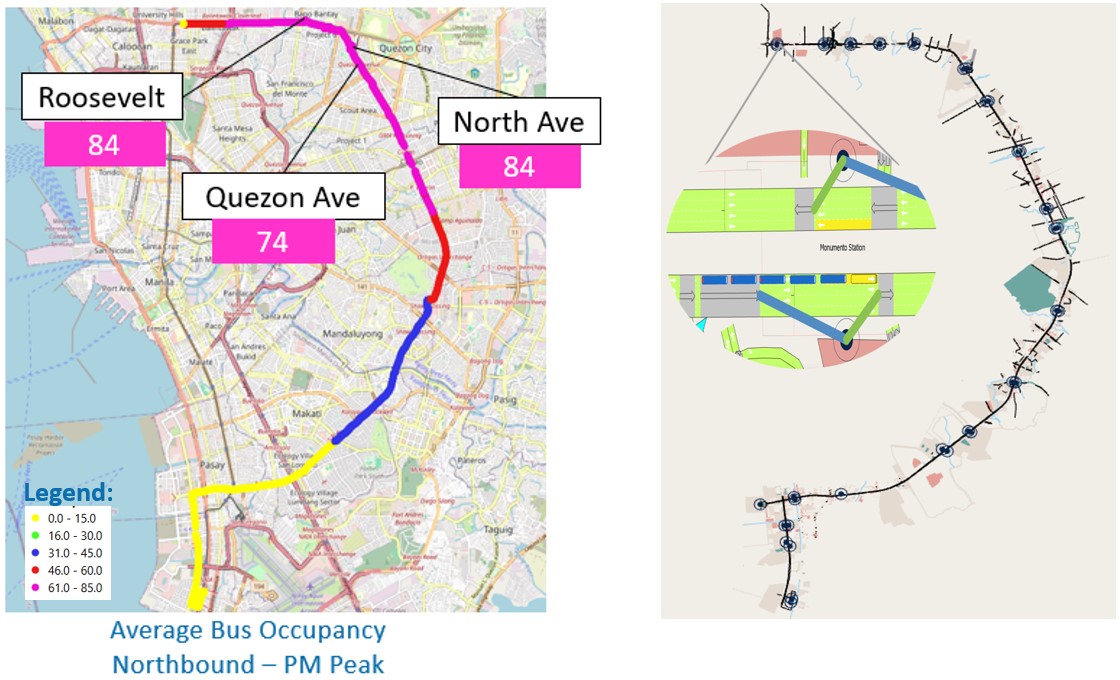
Modeling the performance of exclusive bus lanes remains challenging due to complex behavioral, infrastructural, and policy-related factors. Specifically, I am interested in developing data-driven and scenario-based microsimulation models that capture the dynamic behavior of buses under various operational settings, such as dwell time regulation, headway control, and lane management. This approach enables the evaluation of travel time reliability, emissions, and fuel consumption without relying solely on theoretical assumptions, thereby producing realistic and evidence-based assessments of network performance.
Key outcomes of this research include the development of a microsimulation framework for the EDSA Busway, integration of mobile crowdsourced data & on-board diagnostics device data, and evaluation of policy scenarios that optimize dwell time and headway to enhance overall network efficiency.
Relevant publication/s on this topic:
- Ollero, L.J., Vergel, K., & Tiglao, N.C. (2024). A Microsimulation Model of An Exclusive Bus Lane: The Case of EDSA Busway . Philippine Transportation Journal, Vol. 7 No. 2, 2024.
- Ollero, L.J., Vergel, K., & Tiglao, N.C. (2025). Assessing the Network Efficiency and Environmental Impact of the EDSA Busway under Transport and Traffic Measures: A Microsimulation and Mobile Crowdsourcing Approach . Journal of the Eastern Asia Society for Transportation studies, Vol. 16, 2025.
Bus Bunching
The following interactive simulation demonstrates the phenomenon of bus bunching. The oval represents a closed-loop route where multiple buses circulate in a clockwise direction. Each moving dot is a bus, and the outward dandelion-like dots indicate passengers waiting at designated stops. As time progresses, passengers accumulate at stops (larger dots mean more waiting passengers). When a bus reaches a stop with many passengers, it experiences a longer dwell time. Meanwhile, the bus behind it encounters fewer passengers, allowing it to move faster and eventually catch up. This process repeats until two or more buses pair up and travel as a single unit, a visual representation of the bus bunching effect. Overtaking is not permitted, as each bus follows the one ahead within the looped route.